
Hinged vs. Sliding Doors in Wire Partition Systems: How to Choose the Right Fit
When planning a wire partition system, most of the focus naturally goes to layout, panel height, and access control. But one of the most important decisions in the design process is the door style. Choosing between hinged and sliding doors in a wire partition system directly impacts workflow, safety, and long-term usability.
At WireCrafters, we manufacture a full line of wire mesh partitions, security cages, and machine guarding systems, including both hinged and sliding door options. The right choice depends on how your facility operates and how the space will be used every day.
If you are looking for guidance on choosing the right wire partition door for your facility layout, this breakdown will help.
Understanding Hinged Doors in Wire Partition Systems
Hinged doors are the most traditional and commonly specified door style in wire partition systems. They operate just like a standard door, swinging open on hinges mounted to a partition panel or structural post.
When Hinged Doors Make Sense
Hinged doors are often the right fit when:
- There is sufficient clearance for the door to swing open fully
- Access is primarily for personnel rather than equipment
- The opening size is standard and does not require oversized access
- Controlled entry with locking hardware is a priority
Our wire partition hinged doors can be outfitted with a variety of locking options, including padlocks, keyed cylinder locks, card readers, and electronic access control. For secure applications such as tenant storage lockers, tool cribs, DEA cages, and evidence storage, hinged doors are often specified for their simplicity and reliability.
In facilities where secure storage is the primary concern, such as pharmaceuticals, manufacturing plants, or distribution centers, hinged doors offer straightforward installation and dependable performance.
Benefits of Hinged Doors
- Simple operation
- Lower profile hardware
- Easy integration with standard locking mechanisms
- Ideal for personnel-only access
Because we manufacture all of our wire mesh partition systems in-house, hinged doors can be customized to match panel height, width, and security requirements.
Understanding Sliding Doors in Wire Partition Systems
Sliding doors operate on a track system and move horizontally rather than swinging outward. In tight or high-traffic areas, this can make a significant difference.
Additionally, we offer sliding doors for wire partitions in single-slide and double-slide configurations. We also manufacture larger sliding tunnel gates for applications that require uninterrupted vertical clearance.
When Sliding Doors Are the Better Option
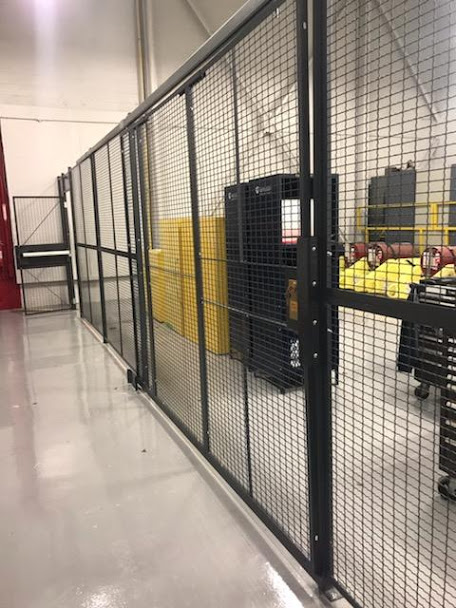
Sliding doors are often preferred when:
- Floor space is limited
- Forklift or pallet jack traffic is frequent
- Oversized equipment must pass through the opening
- Door swing clearance would interfere with operations
For example, in warehouse environments where lift trucks move in and out of secure areas all day, a swinging door can quickly become an obstacle. A sliding wire partition door stays within the plane of the wall, allowing smoother traffic flow.
Our sliding tunnel gate systems are especially popular in high-security warehouses and distribution facilities because they eliminate overhead restrictions while maintaining full-height protection.
Benefits of Sliding Doors
- No swing clearance required
- Ideal for wide openings
- Better suited for material handling traffic
- Efficient use of limited floor space
When integrated into a WireCrafters wire partition system, sliding doors maintain the same visibility and ventilation benefits as our standard panels.
Key Factors to Consider When Choosing Between Hinged and Sliding Doors
If you are specifying a wire partition system for a manufacturing or warehouse environment, consider the following factors before making a decision.
1. Available Floor Space
If your facility layout is tight or equipment is staged near the opening, a hinged door may create interference. Sliding doors eliminate that swing radius and keep traffic lanes clear.
2. Opening Size Requirements
For smaller personnel access points, hinged doors are typically sufficient. For larger openings designed for pallet loads or carts, sliding doors or tunnel gates are often the better solution.
3. Frequency of Use
High-traffic openings benefit from sliding configurations, especially when used by forklifts. For lower-frequency access areas such as secured inventory rooms or maintenance storage, hinged doors are often more practical.
4. Security and Access Control
Both hinged and sliding doors in our partition systems can be equipped with secure locking options. For high-security applications such as DEA cages, driver cages, or secured storage rooms, the choice often comes down to space and traffic flow rather than security level.
5. Maintenance and Durability
Both door types are built from heavy-duty welded wire mesh and structural steel framing. Because our systems are modular, panels and doors can be removed or reconfigured as facility needs evolve.
Application Examples
Here is how the decision often plays out across industries:
- Manufacturing facilities frequently choose hinged doors for tool cribs and maintenance cages, while using sliding doors around robotic cells or large equipment access points.
- Distribution centers often rely on sliding doors for high-volume material handling zones.
- Pharmaceutical and regulated environments commonly specify hinged doors with keyed locking systems for controlled storage areas.
- Data centers and colocation facilities that use our wire partition cages often select hinged doors for individual tenant access, while reserving sliding doors for shared equipment areas.
Because every facility layout is different, our team works directly with dealers, engineers, and facility managers to determine the most effective configuration.
Custom Door Options for Wire Partition Systems
At WireCrafters, we do not treat door selection as an afterthought. Our wire mesh partition systems are fully configurable, and that includes:
- Custom door widths and heights
- Single and double-hinged doors
- Single-slide and double-slide doors
- Sliding tunnel gates
- Integration with electronic access control
- Powder-coated finishes to match facility standards
All products are manufactured in Louisville, Kentucky, and built to withstand demanding industrial environments.
Making the Right Choice for Your Facility Layout
Choosing between hinged and sliding doors in a wire partition system comes down to workflow, clearance, and long-term operational efficiency. The right decision supports safety, improves traffic flow, and ensures secure access without slowing down production.
If you are evaluating wire mesh partitions for your facility and need guidance on door configuration, our team is ready to help. We will review your layout, traffic patterns, and security requirements to recommend the best solution. Contact us today to discuss your next wire partition project and find the right door style to fit your space.

To learn more about WireCrafters, visit www.wirecrafters.com or follow us on YouTube, LinkedIn, Facebook, and Instagram.

